
A building with a room temperature of 21°C is considered comfortable. For decades, this was precisely the technical goal. The heating load was calculated, the heating system was dimensioned, thermostats were set – and with that, the planning task was complete. If it got too warm in the summer, a window was opened or a separate cooling system was added. The principle was clear, linear, and functional.
Doch dieses Denken greift zu kurz und reduziert ein komplexes System auf eine einzelne Zielgröße. Ein Gebäude ist kein statisches System mit Heizkörpern, sondern steht im permanenten energetischen Austausch mit seiner Umgebung. Solare Einstrahlung, Außentemperaturen, interne Wärmelasten, Luftfeuchtigkeit, Nutzerverhalten und Materialeigenschaften beeinflussen kontinuierlich den thermischen Zustand. Gleichzeitig verändern sich die Rahmenbedingungen: Energiepreise entwickeln sich dynamisch, regulatorische Anforderungen steigen, Sommer werden länger und heißer, während Investoren und Eigentümer planbare Betriebskosten über Jahrzehnte erwarten.
In diesem Kontext genügt es nicht mehr, lediglich eine Solltemperatur bereitzustellen. Wer ausschließlich in Heizleistung denkt, plant eindimensional in einem mehrdimensionalen System. Die zentrale Frage lautet daher nicht mehr: „Wie viel Leistung benötigt die Heizung?“ sondern: „Wie kann das Gesamtsystem unter wechselnden Bedingungen stabil und effizient arbeiten?“ Genau hier liegt der Unterschied zwischen Temperieren und Klimatisieren.
One parameter is not enough.
Traditional heating thinking reduces thermal quality to air temperature. However, comfort arises from the operative temperature – that is, from the interplay between air temperature and the average surface temperature of the surrounding building components. Cold window surfaces or insufficiently insulated exterior walls create radiation asymmetries that cause the human body to lose heat, even when the thermometer reads 21°C. At the same time, relative humidity, CO₂ concentration, volatile organic compounds (VOCs), particulate matter pollution, air movement, as well as solar and internal heat loads measurably influence the perceived comfort of a room. A system can be designed according to standards and still function inadequately. CO₂ levels above 1,500 ppm have been proven to reduce concentration and performance. A lack of external sun protection leads to overheating in summer, which can only be compensated for with high energy consumption. The result is a reactive system that constantly responds to external influences instead of proactively controlling them .
Systemarchitektur statt Einzelkomponente
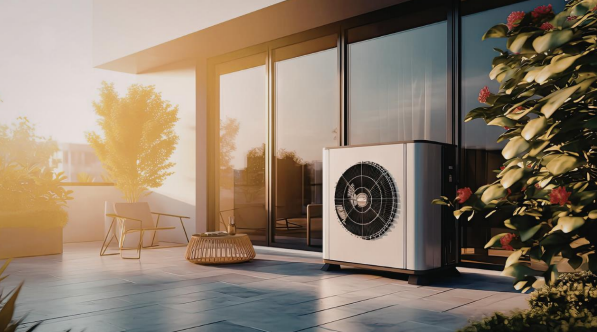
Air conditioning is not a product, but a system architecture. It begins with the building envelope as the primary physical interface between inside and outside. Optimized construction and orientation, minimized thermal bridges, effective insulation and high airtightness, as well as effective sun protection, reduce energy flows right at their source. The goal is not maximum technology, but minimum load. Only a thermally stable and resilient building envelope makes building services technology a driver of efficiency. Heat pumps with reversible functionality enable heating and cooling in a single system. Surface heating and cooling systems distribute energy with low system temperatures and high comfort. Ventilation systems with up to 80% heat recovery directly link energy efficiency with air quality and significantly reduce ventilation heat losses.
Integration is crucial: control strategies, hydraulics, storage, and electricity consumption are not considered in isolation, but optimized as a coordinated overall system. Energy is not just supplied – it is intelligently managed.
Systemvergleich Einfamilienhaus (Beispielrechnung)
Gesamtwärmebedarf inkl. Warmwasser: ca. 20.000 kWh/a
Variante 1: Gas-Brennwertheizung
Investment: approx. €20,000
Energy costs (gas price €0.12/kWh): 20,000 kWh/year × €0.12/kWh = approx. €2,400/year
Cumulative energy costs after 10 years (4% annual increase due to CO2 pricing): approx. €48,000
Total costs after 10 years: approx. €68,000
(losses due to window ventilation not included)
Once the investment has paid for itself, the system operates permanently with lower operating costs and higher thermal stability. At the same time, its dependence on fossil fuel price fluctuations is significantly reduced
.
Performance statt Sollwert
The future of energy-efficient buildings lies not in higher heating outputs, but in higher system performance. Temperature control fulfills a minimum requirement. Air conditioning defines a quality standard. Buildings designed as integrated energy systems deliver stable surface temperatures, controlled air quality, active summer heat protection, and predictable operating costs.